Recently viewed
 Unmasking Guedra Guedra: The mysterious DJ who’s mixing up Morocco’s music scene


In Essaouira, there are sunsets that aren’t like other sunsets. Colors without names that bleed through the hazy sea, stirring all the romantic notions of North Africa in one snapshot: ancient culture, warm hospitality and a sanguine spirit. Heart heaving one moment, uplifting in the next…
This particular sunset, with all its attendant sentiment, was the backdrop for Guedra Guedra’s set at MOGA festival, an electro three-dayer in Morocco, which takes place annually in late September.
The 38-year-old Moroccan-born DJ, musician, producer and sound archivist was on the event’s main stage as the sun slunk over the horizon behind him. His EP, Son of Sun, which I’d listened to the day before, took on a singular significance in that moment.

By his own admission, his music is experimental
Abdellah M Hassak, as his mother calls him, colors western electronic music with the folkloric sounds of Saharan Africa. He specializes in serving up, as dance-music’s arbiter Resident Advisor puts it, “Bedouin themes through a vortex of jungle-inspired beats.” By Hassak’s own admission, his music is experimental, even against the backdrop of the boundary-pushing electronic scene.
Yet, he bats off any notion that he’s a trailblazer. “Moroccan artists have influenced western music for years,” he tells me. “In 1968, The Rolling Stones recorded with musicians from villages in the Rif mountains. Thirty years later, legendary techno DJ, Talvin Singh, did the same thing, collaborating with the ‘Master Musicians of Jajouka’ on his album of the same name,” he explains.

The name ‘Guedra Guedra’ comes from Berber dance music
Hassak’s point of difference is in the sheer number of styles he mixes up: Egyptian shaabi, Moroccan gnawa, Algerian folk or raï, the mystical Islamic sounds of sufi – it goes on. Indeed, his stage name, Guedra Guedra, comes from the Berber (Amazigh) dance music performed on the guedra drum.
His early years in rock and reggae bands have had their sway, too. The result is high-energy, genre-busting music that invites the listener to skip through customs, cultures and epochs.
As his set progressed, I also noticed the structures of the songs were unusual. “Sometimes I incorporate the verse-chorus format of pop music; at other times, between songs, I’m also happy to leave a pause. It doesn’t have to follow the seamless mixes of electro,” he says.
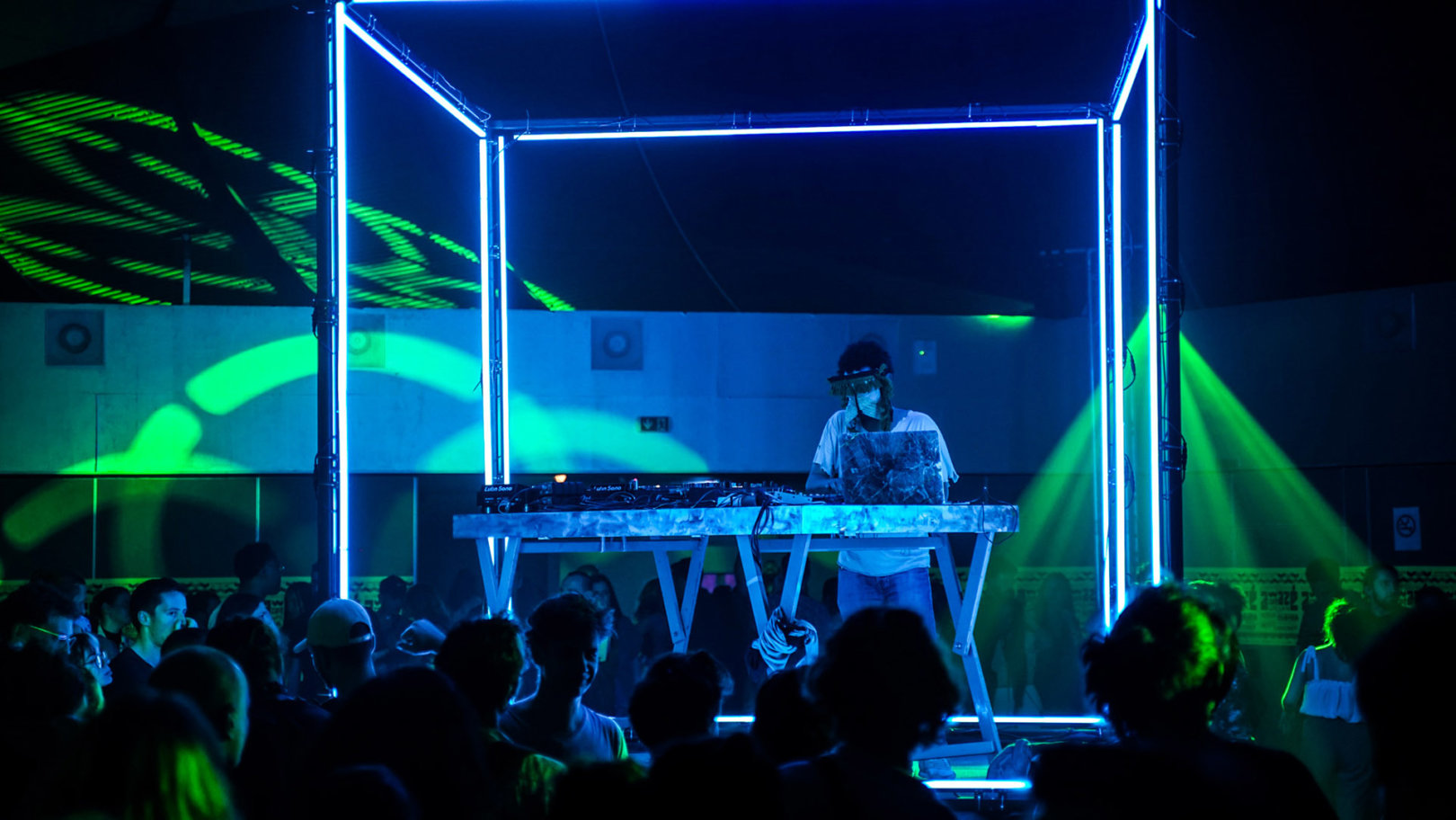
Another idiosyncrasy is the ornate face masks he wears
Another more obvious idiosyncrasy concerns the ornate face masks he wears while performing. Derived from an Amazigh tribe called the Zayane, these symbolic material veils are worn by men and women singing in organized circles, reciting poems and playing bendir drums to reach a collective trance. You can hear the results on his song ‘Aura’.
So much to unpick – but what is he trying to achieve? In a restaurant in Essaouira’s Medina the night after his set, I asked him this exact question.
Our window seat on the sixth floor overlooked the crenellated outer wall of the medina and another sublime sunset behind it. On the ramparts, a collective of traditional gnawa musicians – the town’s homegrown genre – were performing their trancey call-and-response songs to the strains of the crashing waves below.

The music is about bringing people together
We were both sidetracked for a moment before he responded, saying “It’s all about the pleasure of experimenting with sounds that seem disparate but actually complement each other. I want to use music to create space for imagined utopian equality across societies. I try to achieve this by zooming in on phenomenological cultural practices – and seeking the universal.”
He continues, “Of course, I’m interested in showing people the variety of customs and cultures present in the Maghreb (Northwest African) canon, but this is also about bringing people together, mixing bodies and minds across cultures in a single space.”

In Morocco, the electronic scene is growing
Happily, MOGA’s modus operandi seems to be similarly focused on doing just that. A festival created to celebrate and propagate Moroccan culture, its program includes an ‘original creation’ for each event: in 2022, Portuguese producer and DJ, Moullinex, collaborated with local masters to create music that was then performed live at the festival.
MOGA is also interesting for what it symbolizes: a burgeoning domestic dance music scene. Progressive economic policies in Morocco over the past decade have given rise to a growing middle class with disposable income and hungry for new experiences. “Today, there are more and more fans of electronic music and we have some excellent festivals,” says Hassak.
He sees these events as a potentially powerful platform to promote artists that embrace the indigenous sounds and styles of the continent. And the same could be said of his latest album Vexillology, which reviewers have recorded as “a means of retracing African music history, shining a light on its people”. Indeed, he spent a considerable amount of time recording live performances with a host of musicians from Senegal to Tunisia.

Towards the end of the set, Guedra’s delight was palpable
As the crowd packs onto the dance floor in front of the stage, I wonder whether they’re aware of the time travel they’re experiencing, where elements of past and future African music are fused into the (very loud) present moment.
Towards the end of the set, he plays another propulsive song dominated by raï – a style of Algerian folk music associated with the country’s working class. The security guard – around 50 years old – couldn’t hold it in any longer and started dancing with a group of French guys next to him. Hassak’s delight was palpable – the fusion was working.
“In Africa, music is the element that connects the human with the divine world,” he says. A bit like a sunset…
Set the soundtrack to your own Morocco adventure with Flash Pack, which offers three trips throughout the country that take you from the souks to the Sahara and beyond.
Got a story or adventure that could inspire a solo traveler like you? Tag @flashpack on social or email content@flashpack.com to be featured.
Images: ©Joseph Ouechen, ©Hakim Wiseman Joundy, ©Fayssal Zaoui & ©Abel Llavall-Ubach